
Central Texas contractors working along I-35 and other active corridors face a practical decision every week: Is the job’s public traffic setup still aligned with the current phase, and is the internal movement of trucks, equipment, and workers still aligned with how the site is actually operating? That is where construction safety management becomes operational on highway work. On live roadway projects, the most useful field review is often not a broad safety talk. It is a focused superintendent audit of Temporary Traffic Control for road users and Internal Traffic Control for construction movements inside the work zone.
This brief is intentionally narrow to avoid repeating general work-zone guidance. It is built for superintendents, safety managers, and project executives in Austin, Round Rock, San Marcos, Waco, and the broader Central Texas corridor who want a practical way to check whether TTC and internal routing have drifted apart on an active project this week.
Key Takeaways
- According to TxDOT, Texas recorded more than 28,000 work zone crashes in 2025, resulting in 203 deaths, including seven roadside workers.
- A Temporary Traffic Control Plan governs road-user movement through or around the work zone. An Internal Traffic Control Plan governs construction traffic, equipment, backing areas, and worker movement inside it.
- OSHA says most fatalities in road construction work zones involve workers struck by construction equipment or other vehicles, and workers are just as likely to be struck inside the zone as by passing traffic.
- The most useful weekly audit question is simple: Do the current TTC setup and internal routing still match today’s phase and operations?
- For contractors that want stronger field leadership and safer execution, ABC Central Texas Safety Programs are the clearest next step.
The Distinct Field Decision: Audit the Edge and the Interior Separately
Many work-zone discussions blend public traffic control and internal construction movement into one topic. In the field, that can hide the real problem. A project may have an acceptable lane-closure setup for drivers while still exposing crews to backing conflicts, mixed pedestrian-equipment routes, or uncontrolled access points inside the barrels. The opposite can also happen: internal routes may be disciplined while the public-facing taper or device sequence no longer matches the active phase.
For Central Texas highway work, especially on I-35, frontage roads, municipal arterials, and connector projects, the most useful distinction is this:
- TTC audit: Are motorists being guided through the current phase as intended?
- Internal traffic audit: Are workers, trucks, and equipment moving through the work area the way the team believes they are?
If you only review one side, you can miss the drift that creates struck-by exposure.
Temporary Traffic Control vs. Internal Traffic Control
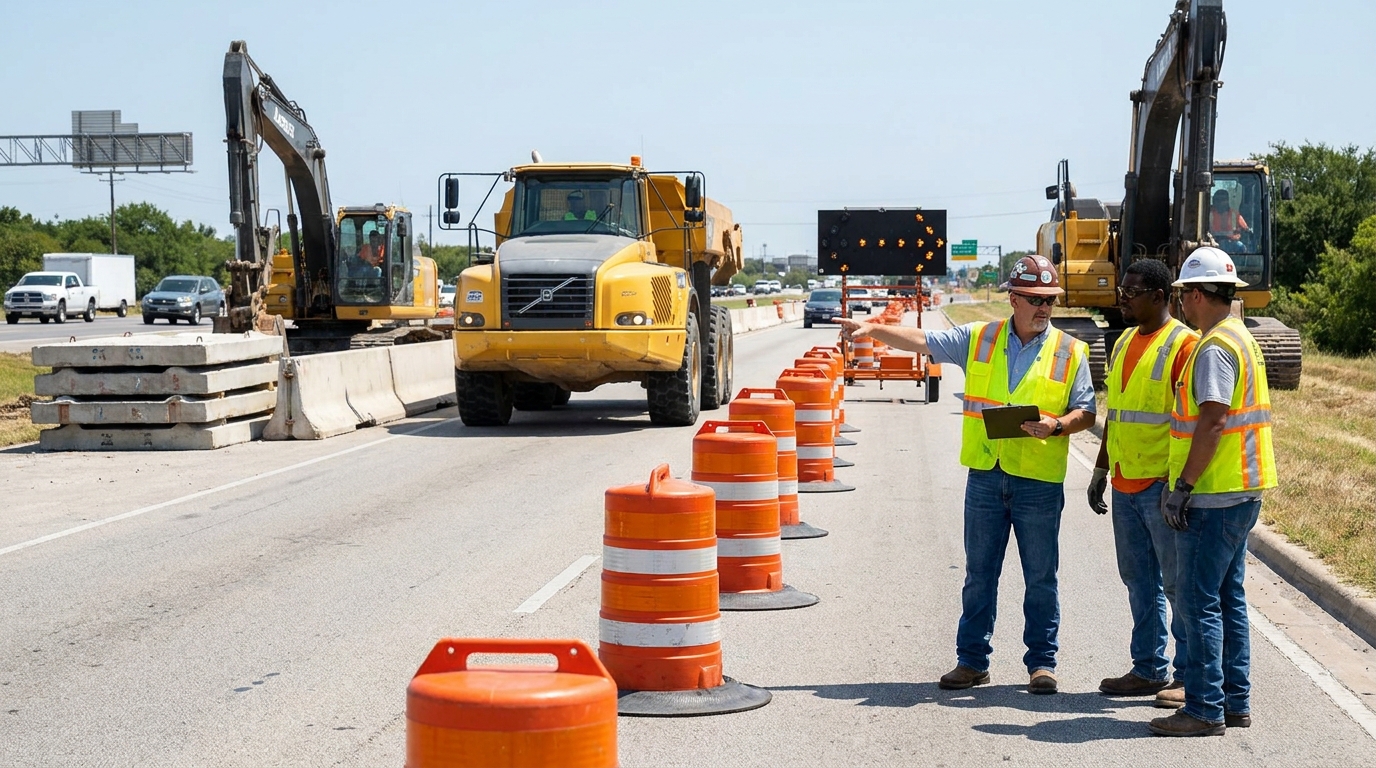
A Temporary Traffic Control plan addresses road-user movement around or through the work zone. It covers lane closures, tapers, signs, arrow boards, channelizing devices, and detours. On TxDOT or similar projects, the field setup should match the approved detail for the active work phase.
An Internal Traffic Control Plan addresses what happens inside the work area. It lays out truck routes, equipment paths, worker walkways, backing zones, laydown areas, and crossing points. OSHA’s roadway construction guidance matters here because internal struck-by risk is not secondary. OSHA notes that highway and infrastructure workers face hazards from both outside and inside the work zone, including struck-by and caught-between hazards.
On a live Central Texas roadway job, the highest-risk breakdown often occurs at the transition between the two systems: where haul trucks enter or leave the work area, where crews cross near equipment paths, or where a phase change alters both the lane closure and the internal staging pattern.
Why This Matters on Central Texas Corridor Work
Roadway jobs in Austin, Round Rock, San Marcos, and Waco often combine tight staging, high traffic volumes, freight movement, changing access patterns, and night work. Frontage-road utility activity, interchange work, paving shifts, and lane-transition work can change the site faster than the paperwork can keep up.
TxDOT’s current public work-zone safety campaign targets drivers, but the contractor takeaway is operational: set the zone defensively because road users will not always behave predictably. TxDOT’s message is direct: slow down, stay alert, never tailgate, watch for road crews, and allow extra time. Contractors should assume the work zone will be inconsistent at the public edge and may be shortcut inside the work area unless field leadership actively checks for drift.
That is why this article focuses on one decision tool rather than a broad overview: a superintendent audit that separates the public edge from the internal operating zone.
A Weekly Superintendent Audit for TTC and Internal Routing
Use this review on one active project each week. Walk the job. Do not complete it from memory or from the truck.
| Audit Area | Field Question | What Drift Usually Looks Like |
|---|---|---|
| TTC phase accuracy | Do signs, devices, taper length, lane closure, and arrow-board use match the current phase? | Old setup left in place after a phase change, moved drums, incomplete sign sequence, damaged devices |
| Internal haul routes | Do truck and equipment paths still reflect where materials, spoils, and crews are actually moving today? | Ad hoc routes, equipment cutting through pedestrian areas, staging shifted without route update |
| Backing exposure | Where are the planned backing areas, and are workers routinely entering them? | Spotters covering too many movements, backing near laydown congestion, no clearly respected no-go space |
| Worker pathways | Can workers reach active tasks, break areas, and crossings without stepping into equipment paths? | Shortcut foot traffic, informal crossings, materials stored in intended walkways |
| Access and egress | Are truck entry and exit points into live traffic visible, controlled, and consistent with the day’s setup? | Temporary gaps cut into devices, conflicting merge movements, unclear truck queuing |
| Night setup | For night work, do lighting, visibility, and warning systems still support both the TTC layout and internal movement? | Dark pockets, glare, dirty reflective gear, weak illumination at crossings or backing areas |
| Multi-employer coordination | Do subcontractors and delivery drivers understand the same routes and restrictions as the prime’s crews? | Different answers from different crews, unauthorized parking, subs creating their own access points |
What to Verify in the Walk
1. Start at the public approach
Walk the approach as a driver would. Check whether the sign sequence, taper, lane closure, and device placement still fit the active phase. Missing or shifted devices are obvious problems, but outdated setups after a phase change can be just as important.
2. Move to the transition points
Pay special attention to access and egress where construction vehicles interact with live traffic. These are common failure points because responsibilities blur between the public-facing setup and internal operations.
3. Walk internal movement from a worker’s perspective
Do not just confirm intended haul routes on paper. Walk from staging to active work areas and note where a laborer, operator, or foreman would actually travel. If the safest route is inconvenient, crews may already be using a different one.
4. Observe backing and staging pressure
OSHA’s emphasis on internal struck-by hazards makes backing zones a core audit item. Look for congestion where trucks, equipment, materials, and workers compete for the same space. If one spotter is effectively managing multiple simultaneous conflicts, the system may be overextended.
5. Confirm communication matches reality
During the pre-shift huddle, crews may be told one route and one crossing point. In the field, they may be using another. Ask a few workers and subcontractor supervisors to describe truck routes, no-go areas, and crossing points. If answers vary, the control system is weaker than it looks on paper.
Clearly Hypothetical Worked Example
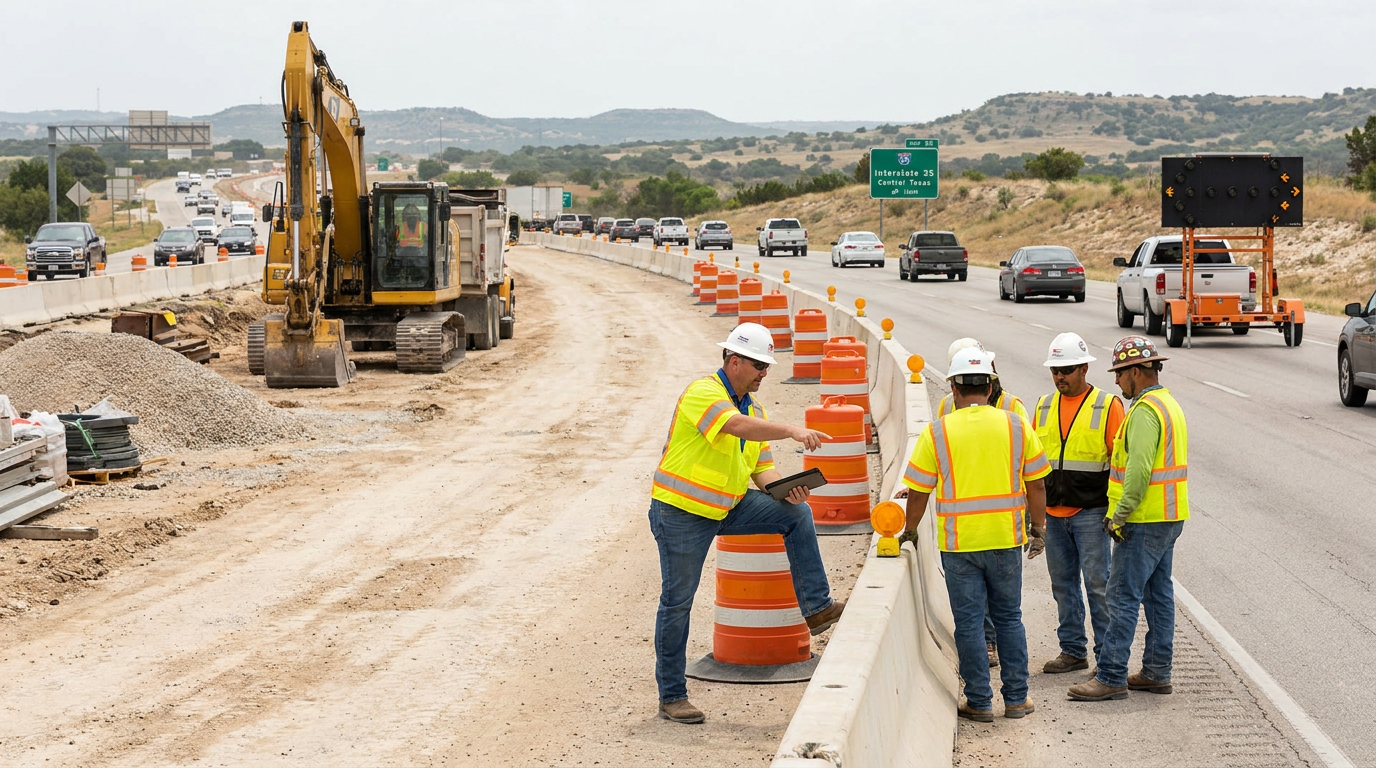
Consider a hypothetical night paving operation on an I-35 frontage road in Central Texas. The TTC setup for motorists is still largely the same as the previous night’s lane closure. But inside the work area, the milling spoil pile has been moved, the water truck is now queuing from a different direction, and the crew is crossing between two pieces of equipment at a point that was not planned as a walkway.
Nothing in that scenario necessarily looks dramatic from the road. A fast drive-by might suggest the zone is in decent shape. But a superintendent using the audit above would likely find three separate issues:
- The internal haul route no longer matches actual truck movement
- The worker crossing point has drifted into an equipment path
- Backing exposure has increased because staging changed without resetting the interior controls
The point is not that every project needs a new plan every day. The point is that active operations change, and the field audit should catch those changes before the shift normalizes them.
Where TTC and Internal Control Usually Drift Apart
On active corridor work, drift usually shows up in repeatable ways:
- The lane closure is current, but internal staging has changed
- Devices at access points get moved for convenience and never fully restored
- Worker walk paths are blocked by materials or equipment, so crews create shortcuts
- Delivery drivers and subcontractors follow different routing assumptions than site leadership
- Night lighting supports production equipment but not pedestrian movement or backing visibility
- One role, often a spotter or foreman, is expected to control too many movements at once
These are management problems more than paperwork problems. They develop when the field setup no longer matches the operating reality of the shift.
How to Use TxDOT and OSHA Guidance Practically
TxDOT states that it maintains traffic-control standards and design practices for state highway construction and maintenance projects and offers work-zone traffic-control training for contractors and other external partners. That makes TxDOT’s resources a baseline reference for state work, not a substitute for field verification.
OSHA’s guidance adds the internal-risk lens that many teams still underweight. The most practical translation for Central Texas field leaders is straightforward:
- Review the current public traffic setup against the active phase
- Review internal routes against actual movements, not intended movements
- Check access points where public and construction traffic interact
- Use pre-shift communication to align crews and subcontractors on that day’s routing
- Correct drift before production pressure makes it routine
ABC Central Texas Resources for Field Leaders
If this audit exposes inconsistent field execution, the next step is supervisor development, not more paperwork. ABC Central Texas Safety Programs provides a practical hub for contractors that want stronger safety leadership, access to OSHA-related training, and more disciplined safety systems across active projects.
ABC Central Texas also states that it is a host-training organization for The University of Texas at Arlington OSHA Training Institute and Education Center and offers online and in-person training. The chapter’s education programs also include safety-related offerings such as OSHA trainings, CPR classes, Construction Site Safety Technician Certification, and STEP support.
For longer-term workforce development, ABC Central Texas says it operates its registered apprenticeship program out of Austin and Waco and offers pathways including Carpentry, Concrete, Electrical, HVAC, Pipefitting, Plumbing, and Sheet Metal. You can learn more on the Registered Apprenticeship page.
Next Step for This Week
Select one live roadway project in your portfolio. Walk it using the TTC-versus-internal-routing audit above. Limit the review to three questions:
- Does the public traffic setup match the current phase?
- Do truck, equipment, and worker movements match the current internal plan?
- Where are the two systems breaking down at access, crossing, or backing points?
Assign corrections the same day. For Central Texas highway contractors, that is one of the most practical ways to turn construction safety management into better field execution instead of another document on the trailer wall.
FAQ: Construction Safety Management on Highway Work Zones
Below are answers to common questions about this topic.
What is the main difference between TTC and internal traffic control on a highway project?
TTC governs how motorists move through or around the work zone. Internal traffic control governs how construction vehicles, equipment, and workers move inside the work area. Both matter, but you should review them separately because different kinds of drift affect each one.
Why focus so much on internal traffic control if public traffic is the obvious hazard?
Because OSHA states that workers in road construction are just as likely to be struck by equipment inside the work zone as by passing traffic. That makes internal routing, backing control, and worker pathways central to field safety, not secondary details.
How often should a superintendent run this audit?
At minimum, run it whenever the project changes phase or site conditions materially affect movement. On active roadway work, a short weekly walk focused on TTC accuracy and internal-routing drift can also be useful.
What usually causes these systems to drift apart?
Common causes include phase changes, moved devices, shifted staging, delivery pressure, informal access points, blocked walkways, and subcontractors following routing assumptions different from the prime contractor’s.
What is the best next step if the audit keeps finding the same issues?
Move beyond correcting devices one by one and strengthen field leadership, training, and communication routines. For Central Texas contractors, ABC Central Texas Safety Programs are a practical place to start.