
Key Takeaways
- Construction worker retention in Central Texas can be supported when field leaders make mental health resources visible, practical, and consistent during Construction Suicide Prevention Week 2026.
- OSHA says construction has one of the highest suicide rates of any occupation and that everyone in the industry has a role in prevention. Separately, CDC data for 2021 reported a suicide rate of 65.6 per 100,000 for males in the Construction and Extraction occupational group.
- A five-day quick-start plan gives superintendents a field-ready sequence: leadership message, toolbox talk, resource posting, foreman coaching, and follow-through documentation.
- Visible mental health resources, access to the 988 Suicide & Crisis Lifeline, and consistent supervisor behavior can strengthen trust on active job sites.
- ABC Central Texas’s construction safety management systems guide and suicide prevention resource page offer additional support for Central Texas contractors.
Why Suicide Prevention Week Matters for Construction Worker Retention in Central Texas
Construction worker retention is not just a payroll issue. It is also a safety, culture, and leadership issue, and that becomes clear in how a company handles mental health on the jobsite.
OSHA says construction has one of the highest suicide rates of any occupation and that everyone in the industry has a role in prevention. Separately, CDC data for 2021 reported a suicide rate of 65.6 per 100,000 for males in the Construction and Extraction occupational group. Those figures are not interchangeable, but together they show why this topic deserves attention from field leadership.
For contractors working in Austin, Round Rock, San Marcos, Waco, and along the I-35 corridor, losing an experienced foreman or craft professional during a personal crisis can disrupt crew stability, project continuity, and day-to-day trust. Competitive pay still matters, but retention also depends on whether workers believe their supervisor will respond professionally when someone is struggling.
This article gives superintendents and general foremen a practical five-day quick-start plan for use during Construction Suicide Prevention Week 2026. The goal is simple: make support visible, make conversations easier to start, and make escalation steps clear without turning supervisors into counselors.
The Practical Decision: What Can a Superintendent Actually Change This Week?
The most useful question is not whether a single awareness week can solve a workforce problem. It cannot. The better question is whether a superintendent can make support more visible and more actionable in one week without disrupting the job.
In most cases, yes.
This plan focuses on what a superintendent or general foreman can realistically influence on an active project:
- The tone of daily kickoffs and morning huddles
- The topic, timing, and delivery of toolbox talks
- What gets posted in the trailer, break area, and other high-traffic locations
- How foremen are coached to respond when something seems off
- How concerns are escalated when someone may be in crisis
Even on a high-pressure project, a superintendent can usually devote 10 to 15 minutes a day to this topic by using existing meetings instead of creating a separate event. The point is not to halt production. It shows that mental health belongs in normal safety practice.
If your company needs a broader systems approach after the week, ABC Central Texas’s construction safety management systems guide covers longer-term rollout and documentation. This article stays narrower on purpose: what field leaders can do now.
A Superintendent’s 5-Day Quick-Start Plan
Day 1: Set the Tone With a Short Leadership Message
Start with the morning huddle. The superintendent sets expectations that mental health is part of safety and that the crew will hear practical support information during the week.
Cover these points:
- Acknowledge job pressures such as heat, traffic, schedule demands, long commutes, and time away from family.
- State clearly that mental health and physical safety are both safety topics on this job.
- Explain that the team will review resources and response steps during Construction Suicide Prevention Week 2026.
- Emphasize that asking for help or raising a concern about a coworker is a responsible action.
Tell the crew that workers or family members can call or text 988 any time through the 988 Suicide & Crisis Lifeline if they are in emotional distress or thinking about suicide.
Day 2: Run a Toolbox Talk People Can Actually Use
Keep the toolbox talk focused on practical actions, not clinical language.
A simple structure works well:
- Why this matters in construction. OSHA identifies construction as an industry with unusually high suicide risk and says everyone in the industry has a role in prevention.
- What coworkers may notice. Examples can include major changes in behavior, unusual risk-taking, withdrawal from the crew, or hopeless comments.
- What to do next. Talk to the person privately, then involve a foreman, superintendent, HR contact, or other designated company resource.
- Where help is available now. Share 988 and any employer support contacts that are already available.
The goal is not to turn workers into counselors. It is to make it normal to notice, ask, and involve the right next person.
For contractors that want supporting background, ABC Central Texas also publishes broader guidance on mental health in construction safety and suicide prevention in construction.
Day 3: Make Resources Easy to Find
By midweek, the superintendent’s job is to make sure resources are visible where workers actually spend time.
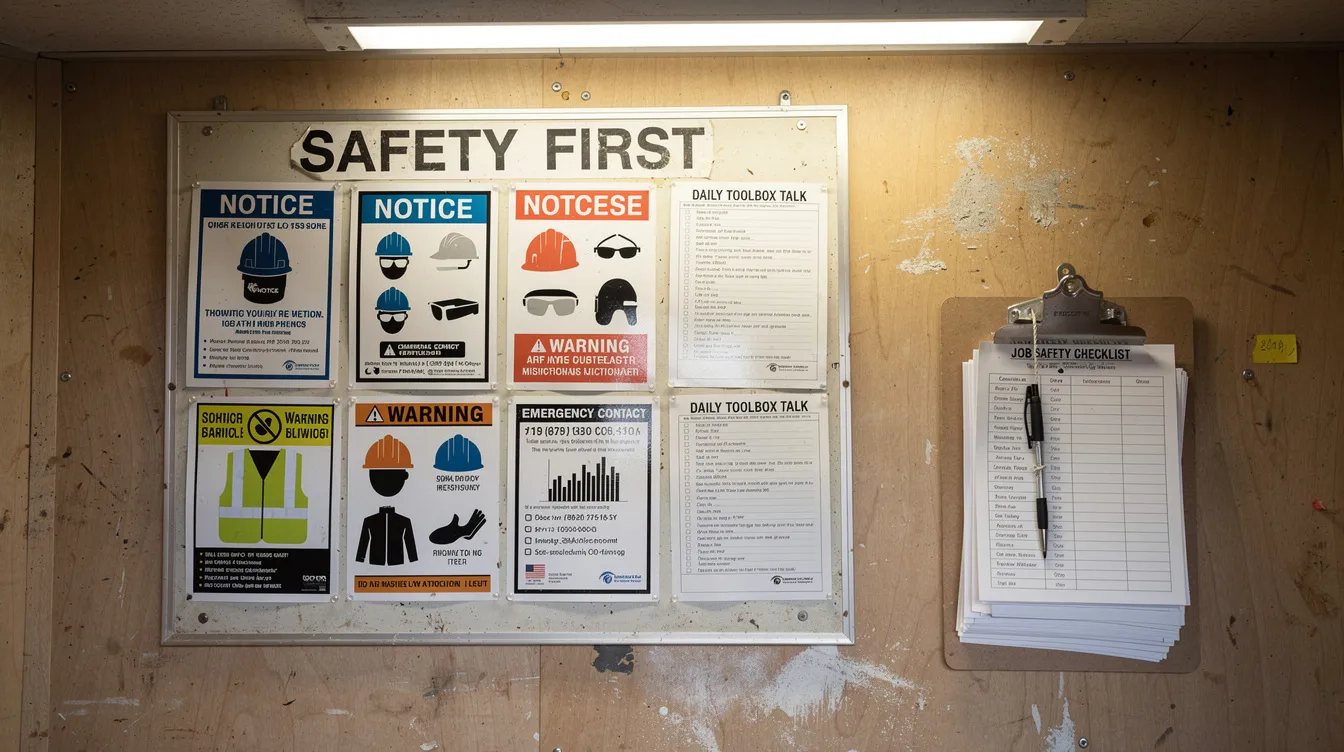
Use this posting checklist:
- Post OSHA’s construction suicide-prevention materials in the trailer, break area, or other visible indoor spaces.
- Post a simple 988 contact notice near time clocks, water coolers, and break areas.
- Post any employer-provided support contacts, clearly labeled, where available.
- Identify who on that project workers can approach first if they are worried about themselves or a coworker.
Keep materials legible, protected from weather, and easy to spot. If crews never see them, they do not function as support.
Day 4: Coach Foremen on Private Conversations and Escalation
Foremen and lead persons often notice meaningful changes in behavior first. They need clear language and a simple escalation path.
Cover these basics in a short foreman huddle:
- Pull the worker aside privately.
- Use simple, nonjudgmental language such as, “You seem off today. I wanted to check in.”
- Listen more than you talk.
- If there is any mention of self-harm or suicidal thoughts, stay with the person and follow your company’s escalation process. Use 988 or emergency services based on urgency.
- Do not promise total secrecy if safety is at risk.
- Do not minimize what the person shares.
This is also the day to confirm who is responsible for contacting HR, safety, or emergency services if a situation escalates.
Day 5: Close the Loop and Keep What Worked
Friday should not feel like the end of a campaign. It should feel like the point where the site decides what stays in place.
Key actions:
- Recap the week in a short huddle.
- Reinforce that mental health is part of safety and that speaking up is allowed.
- Document what was done, including talks delivered, postings completed, and supervisors briefed.
- Note any gaps, such as unclear escalation contacts or missing bilingual materials.
- Confirm that 988 and other public resources will remain posted after the week.
Observation Checklist: What to Look For on a Real Jobsite
If you add only one original field tool this week, make it this observation checklist. It helps superintendents and foremen decide whether support is actually visible on the job, not just planned in a meeting.
| Area to check | What good looks like | Warning sign |
|---|---|---|
| Morning huddles | Mental health is mentioned plainly as part of safety | The topic is avoided or treated like a side issue |
| Postings | 988 and other approved resources are visible in crew traffic areas | Resources are buried in paperwork or missing |
| Foreman readiness | Foremen can explain who to call and what to say first | Foremen are unsure who owns the next step |
| Crew response | Workers know where help is posted and who to approach | Workers have not seen the materials or do not know the contact path |
| Follow-through | Resources stay posted, and gaps are documented | Everything disappears once the week ends |
This checklist also helps with construction worker retention because it shifts the conversation from slogans to visible leadership behavior.
A Clearly Hypothetical Example
Consider a hypothetical Central Texas commercial project with multiple subcontractor crews, a long commute pattern, and a compressed schedule. The superintendent has limited time and knows some workers will tune out a long presentation.
Instead of holding a one-time event, the superintendent uses existing daily meetings for five short actions: a Monday kickoff, a Tuesday toolbox talk, a Wednesday posting sweep, a Thursday foreman huddle, and a Friday recap. By the end of the week, the crew may not remember every talking point, but they do know where 988 is posted, who they can approach first, and that supervisors have been told not to ignore warning signs.
That does not prove a retention outcome by itself. It does show what credible follow-through looks like on a busy jobsite.
How This Supports Construction Worker Retention
Construction worker retention improves when workers believe leadership takes their well-being seriously. A single awareness week does not solve that on its own, but it can reveal whether a company treats support as part of jobsite leadership rather than an HR slogan.
Visible support for behavioral health can strengthen trust, reduce hesitation about speaking up, and make crews more likely to view the job as sustainable during stressful periods. On large projects in Central Texas, that matters because team stability affects communication, quality, and day-to-day execution.
That does not mean you can measure every retention outcome back to one week of activity. It means the behaviors built during that week, if sustained, can support a stronger safety culture and a more credible workplace.
What to Keep in Place After the Week Ends
The simplest way to make this effort credible is to keep a few habits in place after the awareness week is over.
- Leave 988 and other approved public support information posted year-round.
- Keep mental health topics in the normal toolbox-talk rotation.
- Make sure new foremen understand the escalation path.
- Update project contacts when leadership assignments change.
- Review whether workers can still easily find support information 30 days later.
If your company wants to move from a one-week field plan to a more repeatable process, ABC Central Texas’s construction safety management systems article is the better next read.
How ABC Central Texas Can Help
ABC Central Texas serves merit shop commercial construction across Greater Austin, the I-35 corridor, Waco, and the broader Central Texas region. For contractors that want to strengthen this part of jobsite leadership, the chapter already provides public guidance on suicide prevention and mental health in construction safety.
A practical next step is to compare your current toolbox talks, postings, and supervisor escalation process with ABC Central Texas resources on suicide prevention in construction and mental health in construction safety. If your team needs broader support, ABC Central Texas can also connect members with relevant safety education and training opportunities.
Frequently Asked Questions About Construction Worker Retention and Suicide Prevention Week
Below are answers to common questions about this topic.
What if my company does not have a formal mental health benefits program?
Superintendents can still post and discuss free public resources such as the 988 Suicide & Crisis Lifeline. The most important first step is making sure workers know where to find immediate help and who on the project they can approach.
How should we handle confidentiality if a worker shares suicidal thoughts?
Respect privacy by limiting who is informed, but do not promise total secrecy when safety is at risk. Follow company protocol, and if needed, contact 988 or emergency services to help keep the worker safe.
Can subcontractors on our site be included in Suicide Prevention Week activities?
Yes. General contractors and construction managers should make posted resources and toolbox talks accessible to all crews on site where practical.
How do we keep crews from seeing this as a temporary campaign?
Demonstrate consistency. Leave resources posted, revisit the topic during the year, and make sure supervisors handle real concerns professionally. Crews pay more attention to repeated behavior than to one week of messaging.