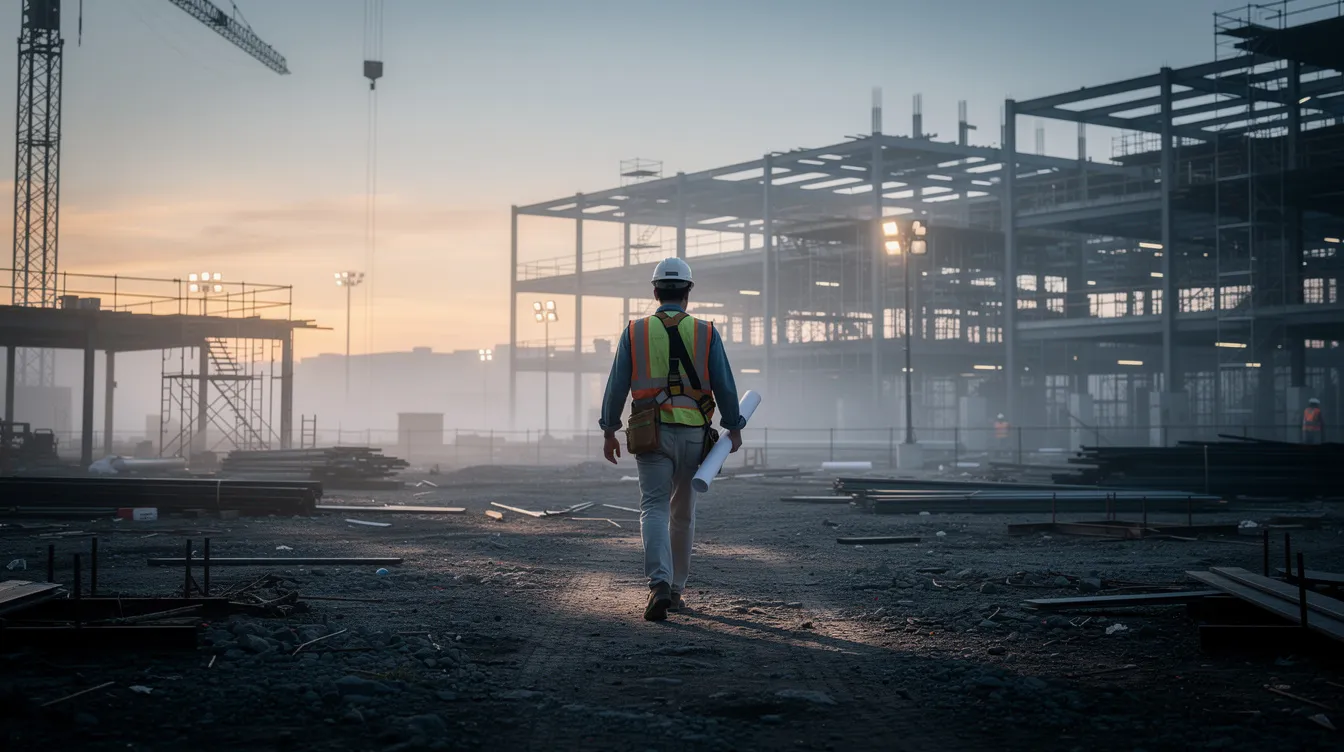

Every day on Central Texas jobsites, electricians troubleshoot panels in empty mechanical rooms, superintendents walk floors before dawn, and punch crews finish tasks long after the main crew has left. These workers are alone. When something goes wrong for a lone worker, the biggest risk is often not the initial incident itself. It is the delay before anyone knows help is needed.
Lone worker safety construction leaders build into daily operations is not optional, even though OSHA has no general standard devoted to employees working alone. For contractors across Austin, Round Rock, San Marcos, Waco, and the I-35 corridor, the practical question is simple: where are people effectively isolated, and what controls will close the gap between an incident and a response?
Key Takeaways
- OSHA says there is no general standard for employees working alone in construction, but employers must still address recognized hazards under broader safety obligations.
- The danger of lone work is often delayed detection and delayed response, which can turn a manageable incident into a far more serious emergency.
- Construction leaders should treat lone work as both a physical-safety and wellbeing issue, especially when fatigue, stress, heat, and isolation can affect judgment.
- A practical lone worker safety program starts with identifying where lone work actually happens, deciding which tasks should never be done alone, setting check-in rules, and assigning a clear escalation path.
- ABC Central Texas offers safety resources and related guidance through its construction mental health and safety resource and broader safety content to help contractors build stronger field procedures.
Why Lone Worker Safety in Construction Deserves Attention Now
OSHA’s guidance is clear: no general OSHA standard specifically governs an employee working alone, except in certain situations such as emergency response, interior structural firefighting, or permit-required confined spaces. That sometimes leads contractors to assume lone work does not require formal controls. It is a risky assumption.
The better practical reading is this: if a company knows employees are working in isolation and knows that delayed rescue or delayed notification could make an incident worse, leadership should address that risk through planning, communication, supervision, and emergency procedures. That is a prudent safety-management decision, not a loophole discussion.
The larger construction risk picture reinforces the point. The Bureau of Labor Statistics reported 1,032 fatalities in 2024 for the construction and extraction occupational group. CDC data for 2021 also showed a suicide rate of 65.6 per 100,000 among males in that same occupational group. Lone-worker planning should not be framed only around falls, electrical contact, or medical events. Isolation can also intersect with fatigue, stress, and wellbeing in ways that matter to safe decision-making.
That is especially relevant in Greater Austin and along the I-35 corridor, where early-access work, spread-out service operations, after-hours punch lists, remote laydown areas, and one-person site walks are routine. Even on busy projects, a worker can be effectively alone if no one can see them, hear them, or notice quickly when something goes wrong.
What Counts as a Lone Worker on a Construction Site?
A lone worker is any employee who is out of sight or out of normal hearing range of others long enough that assistance could be delayed if an incident occurs. It is not limited to someone on a deserted site. A person can be effectively alone inside a crowded project if the work area is isolated from immediate help.
Common construction examples include:
- An electrician troubleshooting a panel in a remote mechanical room or basement
- A superintendent walking an unfinished floor before the rest of the crew arrives
- A surveyor staking a site with no nearby crew support
- A night security worker patrolling an otherwise empty project
- A service technician making solo visits to occupied buildings
It helps to document a few distinctions in company policy:
- Lone worker: A worker whose location or task creates a realistic chance that an incident would go unnoticed for too long.
- Intermittent supervision: A worker who is checked periodically but still spends meaningful stretches alone.
- Short isolation periods: Even brief tasks can qualify when the location or hazard profile would make a delayed response serious.
The point is not to overclassify every solo moment. It is to identify when isolation meaningfully changes an incident’s consequences.
Why Isolation Changes the Risk Profile
Construction already brings changing hazards, heavy equipment, elevation changes, electrical exposure, heat, traffic, and physical strain. Isolation raises the stakes because it can delay recognition, communication, and rescue.
A fall, sudden illness, heat event, equipment incident, or other emergency may be survivable with quick assistance. The same event can become far more dangerous if no one notices for several minutes or longer. That delayed-response factor is what makes lone work different from the same task performed beside a crew.
Isolation can also affect judgment and wellbeing. For long or stressful solo assignments, contractors should consider whether fatigue, distraction, stress, or reduced willingness to speak up may make a task less safe. That does not require overclaiming research. It is a practical field-management reality: workers who are tired, stressed, or operating alone may be less likely to stop work early or ask for help.
For Central Texas contractors, heat adds another layer. A worker alone on a roof, remote pad, upper floor, or roadside shoulder may have less margin for error during hot-weather operations. That makes lone-worker planning a useful companion to broader safety culture and heat-risk planning.
OSHA’s Position on Working Alone: What It Says and What It Does Not Say
OSHA’s FAQ states that no general OSHA standard addresses an employee working alone. It also notes specific situations where direct requirements do apply.
- Permit-required confined spaces: These tasks have attendant and communication requirements. They are not ordinary lone-work situations.
- Emergency-response and firefighting contexts: Certain standards directly address staffing and response expectations.
- Other specific high-hazard operations: Some activities have their own communication, monitoring, or rescue requirements depending on the standard involved.
OSHA also encourages employers to establish emergency procedures for employees who may be alone, including communication tools such as wireless notification devices or cell phones. That guidance is helpful operationally even where it is not a stand-alone general rule.
For contractors, the important takeaway is straightforward: “no general standard” does not mean “no planning needed.” It means employers should make sensible decisions about known isolation risks, especially where delayed response could worsen the outcome.
Common Lone-Work Situations on Central Texas Jobsites
Safety leaders should build a site-specific list of when lone work actually happens. A useful starting list for Austin, Round Rock, San Marcos, Waco, and I-35 corridor projects includes:
Higher-risk situations that may need tighter controls or a second person:
- Work at height before or after main crew hours
- Electrical troubleshooting in isolated spaces
- Tasks near confined-space access points or restricted areas
- Night or low-visibility roadside work
- Remote equipment operation in separated laydown or storage areas
Moderate-risk situations that still need communication and check-ins:
- Early-morning site walks and equipment checks
- Inspection or quality-control work on upper floors
- Solo service calls to commercial properties
- After-hours punch work after other crews leave
Lower-risk but still potentially isolated situations:
- Administrative work in a remote trailer area
- Inventory checks at storage yards or laydown lots
Not every solo task should be prohibited. But companies should clearly identify which tasks are acceptable with controls, and which should not be performed alone at all.
How to Conduct a Practical Lone Worker Risk Assessment
A useful lone-worker risk assessment asks two questions:
- Should this task be done alone at all?
- If yes, what additional controls are needed because the worker is isolated?
Supervisors can build that review into existing JSAs, pre-task plans, or daily planning forms by checking four areas:
| Assessment Area | What to Ask |
|---|---|
| Task hazards | Could this task involve a fall, electrical exposure, heat stress, struck-by hazard, or other event that might incapacitate the worker? |
| Environment | Is the worker in a remote, enclosed, elevated, traffic-exposed, or low-visibility area? |
| Worker factors | Is the worker new to the task, fatigued, heat-exposed, or otherwise operating with less margin for error? |
| Rescue feasibility | If contact is lost, how quickly could someone realistically locate and reach the worker? |
Most companies should also define a short list of tasks that are effectively “never alone” work. Depending on company operations, that may include many permit-required confined-space entries, selected energized work, and certain high-exposure height tasks where standby support is part of safe execution.
That list does not need to be long to be useful. It needs to be clear.
Building a Lone Worker Safety Program: Policy, Roles, and Check-Ins
An effective program does not need to be complicated, but it should be written. At minimum, a lone-worker procedure should define:
- Who qualifies as a lone worker
- Which locations, shifts, or conditions require added controls
- Which tasks are not allowed to be performed alone
- How check-ins work
- Who monitors those check-ins
- What happens when a check-in is missed
A practical check-in procedure usually covers:
- Method: Call, text, radio, app, or another reliable method that fits the site
- Timing: Intervals based on the seriousness and pace of the task
- Required details: Location, task, expected duration, and when the worker will report clear
- Escalation: Immediate next steps if a response is missed
Assign check-in monitoring to a named person on each shift, with a backup. If no one owns the process, the process usually fails when the day gets busy.
Policies should also address after-hours work, weekend work, and travel between dispersed sites, all of which are common across Central Texas operations.
Choosing Communication Tools Without Overrelying on Technology
Communication is the backbone of any lone-worker control plan. The right tool depends on the environment: basements, high-rise cores, remote yards, highway shoulders, and service routes do not all have the same communication challenges.
Common options include:
| Tool Type | Potential Strength | Common Limitation |
|---|---|---|
| Two-way radios | Useful where on-site communication is more reliable than cell service | Coverage may still be limited by building layout or distance |
| Phone-based check-ins | Simple and familiar for many workers | Depends on the worker being able to respond |
| Wearables or panic-alert devices | Can support faster notification in some environments | Require setup, maintenance, and user confidence |
| Automatic motion or man-down features | May help if a worker cannot manually call for help | Need testing and a response plan to avoid false-alarm confusion |
| Satellite-capable devices | Helpful where cellular coverage is poor | May add cost and process complexity |
The core principle is simple: technology can support lone-worker safety, but it does not replace planning, training, or supervision. Any tool is only as good as the response process behind it.
Supervisor Actions That Make Lone-Worker Controls Real
A written policy matters only if supervisors use it in the field. During daily huddles or pre-task planning, foremen and superintendents should confirm:
- Who will be working alone
- Where that work will occur
- What communication method will be used
- When check-ins are expected
- Who is responsible for monitoring them
- Whether conditions have changed enough to require a different plan
Supervisors also need clear authority to stop lone work when conditions make it unreasonable. That might include weather changes, heat load, fatigue concerns, changed site access, or a task that turns out to be more hazardous than expected.
This is where broader safety culture matters. ABC Central Texas has already emphasized how decision-making strengthens safety culture. Lone-worker controls depend on that same discipline: clear judgment, clear escalation, and no ambiguity about when a worker needs support instead of being left alone.
Connecting Lone Worker Safety to Wellbeing and Safety Culture
Construction Executive’s reporting on working alone helped spotlight an important point: isolation is not only a logistics issue. It can also connect to worker wellbeing. That does not mean every solo assignment creates a mental-health crisis. It does mean isolation can remove informal support, observation, and early intervention that exist when people work near others.
That is one reason regular check-ins matter. They verify location and task status, but they also create an opening for a worker to say they are overheating, overwhelmed, too fatigued to continue safely, or simply not comfortable with the conditions.
For contractors that want to build this into existing safety systems, ABC Central Texas already offers related guidance on mental health in construction safety. The goal here is not to turn lone-worker procedures into counseling sessions. The goal is to ensure the company culture supports speaking up, stopping work, and escalating concerns before isolation turns a manageable problem into a crisis.
Central Texas Implementation Checklist
If your company does not yet have a lone-worker procedure, start with a simple field review this week:
- Identify current lone-work situations: Walk active projects and service routes to see where employees are effectively isolated.
- Create a short “never alone” list: Document tasks that require a second person or dedicated standby support.
- Set check-in expectations: Match the communication method and timing to the task’s risk level.
- Name the monitor: Assign one person per shift to track check-ins, with a backup.
- Define the missed-check-in response: Decide in advance who calls, who goes to the location, and when to contact emergency services.
- Train supervisors first: Make sure foremen and superintendents can recognize lone-work situations and apply the procedure consistently.
- Pilot the process: Test it on one or two projects, then refine it based on what actually happens in the field.
The first step is the most important one: walk your projects and identify where lone work is already happening. Most companies have more of it than they realize.
For contractors across Austin, Round Rock, San Marcos, Waco, and the I-35 corridor, that inventory is the foundation for a more practical, defensible lone-worker safety program. If your team is strengthening safety systems now, ABC Central Texas can help you connect lone-worker procedures to broader supervisor training and safety resources.
FAQs
Below are answers to common questions about this topic.
What is the simplest way to start a lone worker safety program?
Start by identifying where employees are currently working alone or outside immediate sight and hearing range. Then add a basic rule: no one works alone without a designated contact, a reliable communication method, and scheduled check-in expectations that fit the task.
How often should lone workers check in?
No single interval fits every task. A reasonable schedule depends on how quickly an incident could become serious, how isolated the location is, and how reliable communication is at that site. Higher-risk work may justify much tighter check-ins than lower-risk administrative or inspection tasks.
What should happen if a worker misses a check-in?
Your procedure should define the escalation path in advance. That often includes immediate attempts through primary and backup communication methods, reviewing the worker’s last known location, dispatching on-site help when appropriate, and calling emergency services if the risk level or circumstances justify it.
Do small contractors really need written lone-worker procedures?
Yes. Small firms still send people on solo service calls, early site walks, after-hours punch work, and yard tasks. A short written procedure helps create consistent expectations and makes it less likely that response decisions will be improvised under stress.
How can contractors connect lone-worker safety with broader wellbeing efforts without drifting off topic?
Keep the focus on safe operations. Use check-ins, supervisor awareness, and stop-work support to make it easier for isolated workers to report fatigue, heat stress, distress, or unsafe conditions. That keeps wellbeing connected to the practical goal of getting help sooner and making better field decisions.